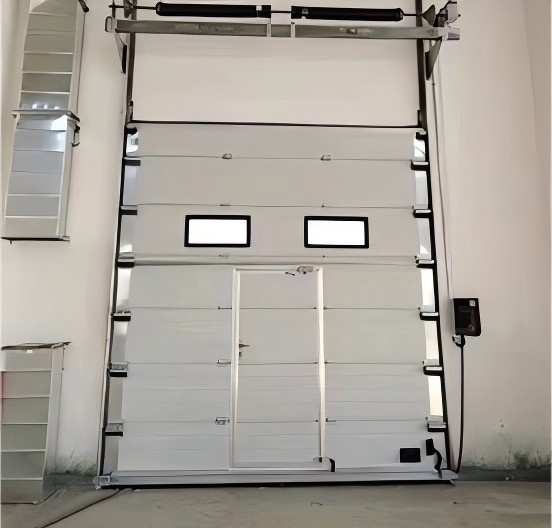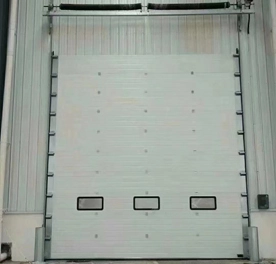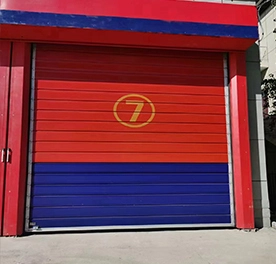
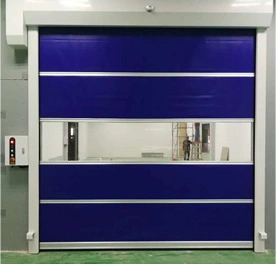
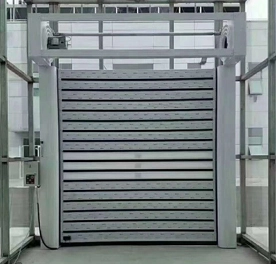
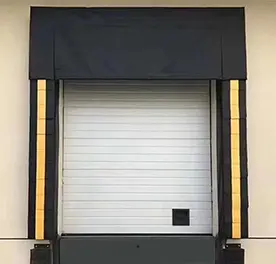
Industrial lifting doors are essential components in modern factories, warehouses, and logistics hubs. Designed for durability, insulation, and high-frequency operation, these doors offer a combination of mechanical precision and intelligent control. At Anbixin, industrial lifting doors are engineered to deliver reliable performance while adapting to different building structures and operational demands.
In this article, we’ll break down exactly how an industrial lifting door works, from its structural components to its working mechanism and safety systems.

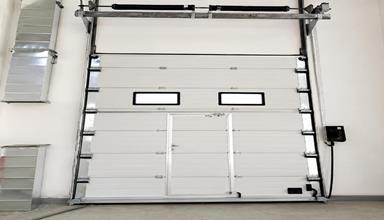
An industrial lifting door (also known as an overhead sectional door) is a vertically moving door system composed of multiple panels connected by hinges. These panels travel along guide rails and open upward, typically resting parallel to the ceiling when fully open.
Unlike traditional swing doors, lifting doors move within their own space, making them highly efficient for industrial environments with limited room.
Vertical or inclined opening movement
Space-saving design
High insulation and sealing performance
Suitable for high-frequency operations
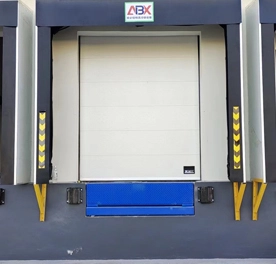
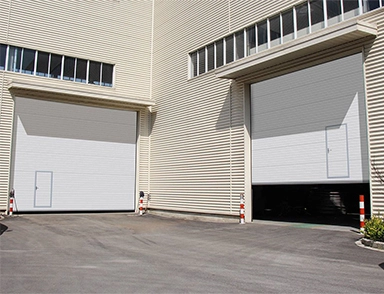
Industrial lifting doors are widely used in logistics centers, cold storage facilities, and manufacturing plants due to their efficiency and adaptability.
To understand how the system works, you first need to know its core components. Each part plays a critical role in ensuring smooth and safe operation.
The door is made of multiple horizontal panels, usually constructed from double-layer galvanized steel with polyurethane insulation. This structure ensures strength, thermal insulation, and durability.
Installed on both sides of the door opening, guide rails control the movement path. They ensure the door moves in a straight, stable line without deviation, improving both safety and sealing.
The torsion spring system balances the weight of the door. Instead of the motor lifting the entire load, the springs store mechanical energy and counterbalance the door weight, making operation smoother and more energy-efficient.
The motor provides the power needed to open and close the door. It works together with the spring system, guiding rather than fully lifting the door.
This includes:
Push buttons
Remote control
Sensors (radar, infrared, etc.)
These systems allow automated and flexible operation.
Industrial lifting doors include multiple safety features such as:
Anti-fall devices
Cable break protection
Safety edge sensors
These systems prevent accidents and ensure safe operation during movement.
The working principle of an industrial lifting door is a coordinated process involving mechanical balance and motor-driven movement.
The system is triggered by a control signal—this could be a button, remote, or sensor detecting a vehicle or person.
The motor starts rotating, transferring power through a shaft or chain system.
Instead of lifting the full weight, the motor works alongside the torsion springs. The springs release stored energy, reducing the load on the motor and ensuring smooth lifting.
The door panels move upward along the guide rails. Rollers attached to the panels ensure precise alignment and prevent shaking.
Once the door reaches the top, it transitions along horizontal tracks and rests parallel to the ceiling.
The system automatically stops when reaching preset limits, ensuring consistent positioning every time. This entire process allows the door to operate efficiently, smoothly, and safely—even in high-frequency industrial environments.
Industrial lifting doors are highly adaptable and can be configured in multiple lifting styles depending on building structure.
Door moves upward and then horizontally
Most common configuration
Door moves straight up without bending
Ideal for high-ceiling facilities
Combination of vertical and horizontal movement
Suitable for medium-height spaces
Tracks follow the roof slope
These variations allow lifting doors to maximize space utilization and adapt to different architectural conditions.
Safety is a critical aspect of industrial lifting door design. Because these doors involve heavy moving parts and high-tension components, multiple protection systems are integrated.
Prevents the door from falling if a cable or spring fails.
Stops the door immediately if an obstacle is detected during closing.
Locks the shaft in place if the torsion spring breaks.
Ensures the door stops precisely at fully open or closed positions.
These systems ensure operator safety, equipment protection, and long-term reliability.
Industrial lifting doors are not just about opening and closing—they are designed to improve operational efficiency.
Space Saving: No swing radius required
Thermal Insulation: Reduces energy loss
Fast Operation: Suitable for high-traffic areas
Durability: Long service life under heavy use
Custom Adaptability: Multiple lifting methods
At Anbixin, lifting doors are designed with these advantages in mind, ensuring they meet the demands of modern industrial environments.
Industrial lifting doors are widely used across different industries:
Warehouses and logistics centers
Cold storage facilities
Manufacturing plants
Automotive workshops
Distribution hubs
Their ability to handle large openings, frequent usage, and harsh environments makes them a preferred solution in industrial infrastructure.
An industrial lifting door works through a balanced system of mechanical components, motorized drive, and intelligent control. The combination of torsion springs, guide rails, and automation ensures smooth, efficient, and safe operation.
From structural design to safety systems, every element is engineered to handle demanding industrial conditions. Anbixin continues to refine these systems, providing reliable lifting door solutions that improve efficiency, safety, and long-term performance.
Most industrial lifting doors last 10–20 years, depending on usage frequency, maintenance, and environmental conditions.
Yes, they are highly customizable in size, lifting method, insulation level, and control systems to match specific industrial needs.
Regular inspection of springs, cables, rollers, and safety devices is recommended to ensure safe and smooth operation.
Yes, insulated panels and tight sealing help reduce heat loss, making them suitable for temperature-controlled environments.
Many systems include manual operation or backup mechanisms, allowing the door to be opened safely when power is unavailable.